
What Are Brand Mentions?
Brand mentions explained: what they are and why they matter
Every time your brand is named in media, it shapes perception. Here is how to understand, track, and act on those moments.
Track every brand mention across Nordic media
Explore how Tonar surfaces brand mentions across Nordic audio and video media, so nothing important slips past you.
Brand mentions are everywhere, not just in articles you find
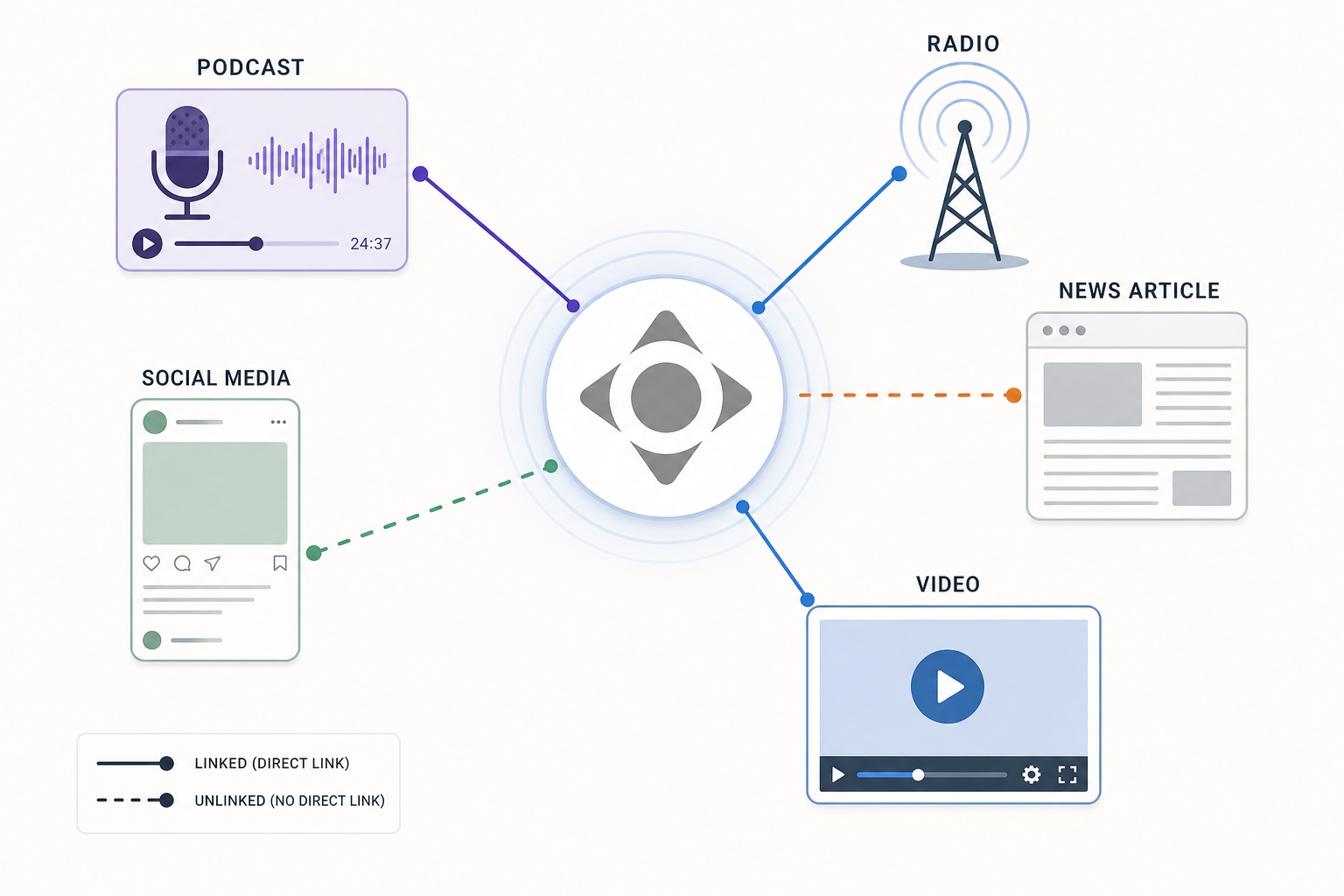
A brand mention is any instance where your brand name, product name, or a closely associated term appears in published content, whether that is a news article, a social media post, a blog, a forum thread, a review, a podcast episode, or a broadcast segment. The mention does not need to include a link back to your website to count. It simply needs to name you.
This breadth matters. Most coverage of a brand happens in places that are not straightforward to track: a morning radio discussion, a podcast interview, a short-form video clip. Text-based monitoring tools catch a portion of this, but audio and video content is where a significant share of brand conversation now lives, and it is routinely missed by teams relying only on web crawlers.
For brand monitoring purposes, a mention is the atomic unit. Everything else, sentiment, reach, context, competitive framing, builds from it.
Linked vs. unlinked mentions and why the difference matters
Not all mentions carry the same mechanics. A linked mention includes a clickable hyperlink to your site, passing referral traffic and, in SEO terms, link authority. An unlinked mention names your brand in plain text with no hyperlink attached.
Unlinked mentions are far more common than linked ones in real-world media coverage. Many publishers restrict outbound linking for editorial or technical reasons even when they are perfectly willing to name a source. This means the majority of your actual media coverage will never appear in a backlink audit.
From an SEO standpoint, Google processes unlinked mentions as implied trust and entity signals that reinforce authority and relevance, even though they do not pass link equity directly. They contribute to entity recognition and topical association in ways that influence rankings over time. Unlinked mentions also frequently precede linked coverage: a journalist who references a brand once is more likely to link to it in future articles once familiarity is established.
For PR and communications teams, the distinction is practical: unlinked mentions are conversion opportunities. They represent coverage that already exists and can often be turned into backlinks through a short, well-timed outreach email.
Sentiment and context turn raw mentions into usable intelligence
Knowing that your brand was mentioned is the starting point, not the destination. The real value comes from understanding the tone and context of each mention. Sentiment analysis at the entity level tells you whether a specific reference to your brand was positive, negative, or neutral, distinct from the overall tone of the article or episode it appeared in.
Context matters just as much as sentiment. A brand mentioned alongside a product recall is very different from a brand mentioned as a recommended solution. Topic-linking, which maps which subjects are associated with your brand in media conversations, reveals the narrative frame your brand is being placed in, not just whether the coverage was good or bad.
For communications teams, this distinction is what separates reactive PR from genuine media intelligence. A spike in mentions is worth investigating only once you know whether it reflects a crisis, a campaign landing well, or a competitor comparison. See sentiment analysis for a closer look at how tone tracking works in practice.
Converting unlinked mentions into backlinks is a high-return tactic
Unlinked mention outreach is one of the more efficient link-building approaches available, because the groundwork is already done: the publisher has already chosen to name you. Outreach to unlinked mentions typically converts at significantly higher rates than cold link-building requests, because you are not asking someone to vouch for a brand they have never referenced.
The mechanics are straightforward. Find the mention, identify the author or editor, and send a short personalised email referencing the exact mention. Frame the request as an editorial improvement, not a favour: adding a link gives the reader a direct path to the source being discussed. Speed matters too. The faster you contact the author after publication, the higher your conversion rate, since the article is still fresh and the author is more likely to remember writing it.
Focus your outreach on mentions where the tone is positive or neutral. A negative mention is better handled as a reputation issue than a link-building opportunity. For teams managing this at scale, a brand mention tracking workflow that flags new unlinked mentions as they appear makes the difference between acting quickly and missing the window.
Audio and video are the blind spot in most monitoring setups
Text-based monitoring tools have matured considerably, but they cover only the content that exists as readable text on the web. Podcasts, radio broadcasts, streaming video, and short-form audio clips are largely invisible to them unless a transcript has been published separately, which most have not.
This gap is not trivial. A brand discussed on a popular podcast reaches an engaged audience that may never see a written article about the same topic. A radio segment that frames a brand negatively can shape listener perception before any written coverage appears. Monitoring audio and video requires transcription first, and transcription quality in Nordic languages specifically depends on models trained on those languages, dialects, and real broadcast conditions.
Tonar's platform addresses this by continuously transcribing audio and video content across podcasts, radio, streaming platforms, and social media clips, then running entity recognition and sentiment analysis on the resulting text. The result is that mentions which would otherwise be invisible become part of the same intelligence picture as text-based coverage. For teams comparing options, broadcast monitoring tools vary significantly in how well they handle spoken-word content.
The mentions that shape your reputation most are the ones happening in audio and video, where most monitoring tools simply do not listen.
Benefits
Reputation issues surface before they escalate
Systematic mention monitoring means a negative reference in a podcast or broadcast is flagged as soon as it is published, not days later when written coverage picks it up. Early detection gives communications teams time to assess context and respond on their own terms.
Competitive positioning becomes concrete and trackable
Tracking mentions across your brand and its competitors reveals not just volume but tone and topic associations, showing you exactly how each brand is framed in media conversations. This turns competitor benchmarking from a periodic exercise into a continuous intelligence feed.
Unlinked mentions become a link-building pipeline
Every unlinked mention is a potential backlink waiting for a well-timed outreach email. Monitoring that flags new unlinked mentions in near real time lets SEO teams act while the article is still fresh, when conversion rates are highest.
Sentiment trends reveal shifts in brand perception
Aggregate sentiment data across mentions over time shows whether the overall tone of coverage is improving or deteriorating, and which topics are driving the change. This is more actionable than raw mention counts because it connects changes in public perception to specific events or narratives.
Audio and video coverage enters the intelligence picture
Podcasts, radio, and streaming content account for a large share of media consumption but are invisible to text-only monitoring. Transcription-based monitoring closes this gap, ensuring that brand mentions in spoken-word media are tracked, analysed, and acted on alongside written coverage.
Brand mention monitoring in practice
PR team catches a damaging podcast mention early
A communications team at a consumer brand discovers, through audio monitoring, that a well-known podcast host made a critical comment about their product in an episode published two days earlier. Because the mention was transcribed and flagged with negative sentiment, the team can listen to the exact audio clip, assess the context, and prepare a response before the story spreads to written media. Early detection in audio is what makes the difference between getting ahead of a narrative and reacting to it after it has already circulated. Without transcription-based monitoring, this mention would have gone unnoticed until it appeared in a journalist's follow-up article.
Marketing director benchmarking share of voice against competitors
A marketing director at a mid-sized Nordic company wants to understand how often their brand is mentioned relative to two key competitors across broadcast and podcast media. By tracking mention volume and sentiment for all three brands over a rolling period, they can see not just how much coverage each brand receives but which topics each brand is associated with in those conversations. This feeds directly into messaging strategy: if a competitor is consistently framed as the innovation leader in audio coverage, that is a positioning gap worth addressing. For a structured approach to this kind of analysis, measuring share of voice provides a useful framework.
SEO team building backlinks from existing unlinked coverage
An SEO team at a B2B software company runs a systematic audit of unlinked brand mentions across news sites, industry blogs, and podcast show notes. For each unlinked mention, they identify the author, verify the tone is positive or neutral, and send a short personalised outreach email referencing the specific mention. Outreach anchored to an existing mention converts at a meaningfully higher rate than cold link requests, because the publisher has already demonstrated willingness to name the brand. The team prioritises recently published mentions to maximise response rates, turning a passive monitoring workflow into an active link acquisition channel.
Agency managing reputation reporting for multiple brand clients
A media agency handles brand monitoring and reporting for several Nordic clients across different sectors. Each client needs to understand how their brand is being discussed in audio and video media, not just in written press. By using a platform that transcribes and tags mentions across radio, podcasts, and streaming content, the agency can deliver reports that include sentiment breakdowns and topic associations for each client, covering the full media landscape rather than just the text-based portion. Auto-label rules let the team apply client-specific tagging logic automatically, so the same monitoring infrastructure serves multiple clients without manual re-sorting for each report.
What are brand mentions? Common questions answered
See every brand mention across Nordic audio and video media
Understanding brand mentions is the first step. Acting on them, whether that means catching a reputation issue early, benchmarking against competitors, or converting unlinked coverage into backlinks, requires monitoring that covers the full media landscape, including the audio and video content most tools miss. Explore how Tonar tracks brand mentions across Nordic podcasts, radio, and streaming media and turns them into structured intelligence you can use.