
Named Entity Recognition: What It Is and How It Works
Named entity recognition turns raw text into structured intelligence
Understand how NER identifies people, brands, and places in text, and why it matters for media monitoring.
See entity recognition built for Nordic media
Explore how Tonar applies entity recognition to Nordic audio and video media at scale.
What named entity recognition actually does
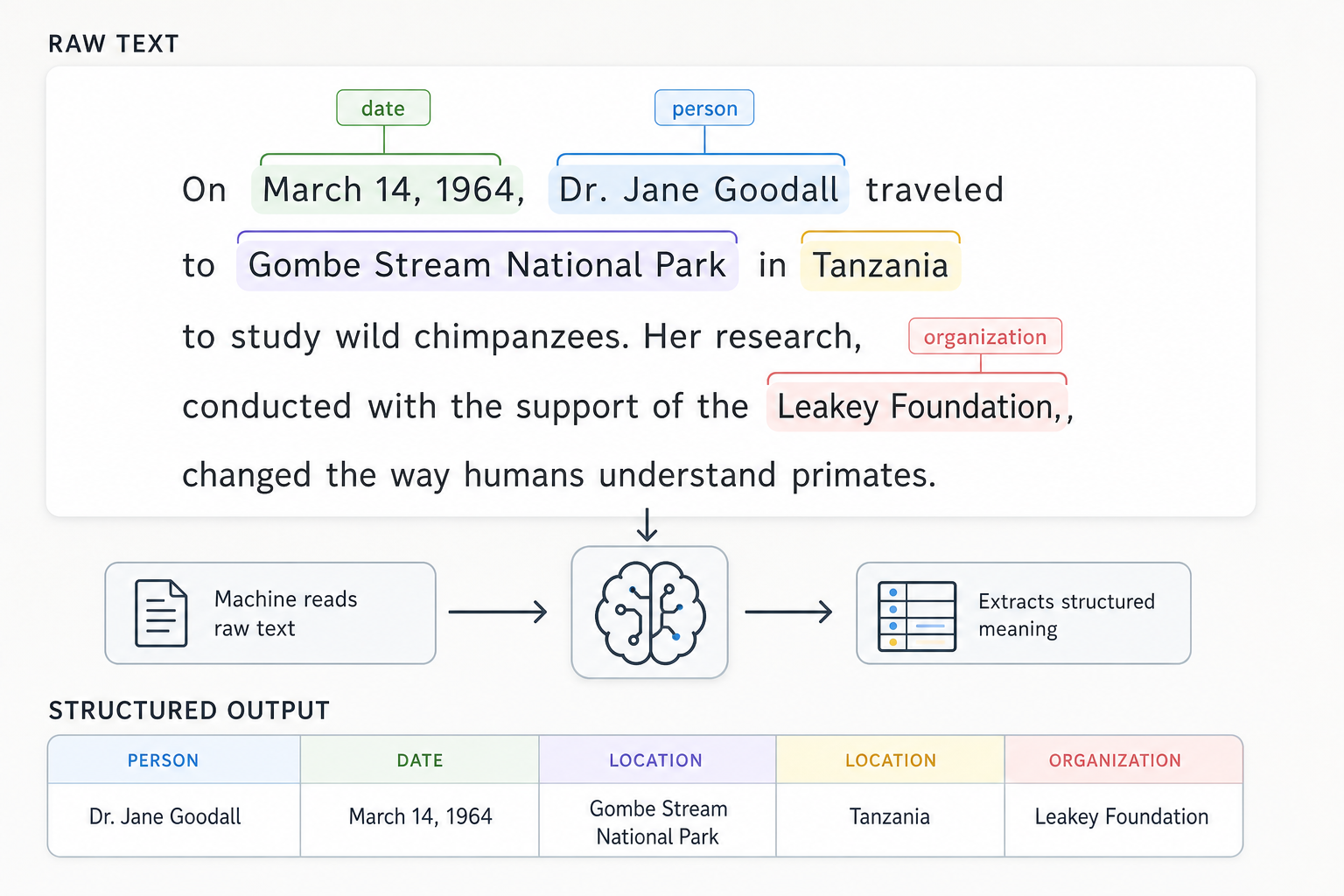
Named entity recognition (NER) is a technique within natural language processing that automatically identifies specific words or phrases in text and classifies them into predefined categories: people, organizations, locations, dates, monetary values, percentages, and more. Take the sentence "Apple CEO Tim Cook announced a billion-dollar investment in Austin." An NER system reads that sentence and tags "Tim Cook" as a person, "Apple" as an organization, "a billion dollars" as a monetary value, and "Austin" as a location. The raw sentence becomes structured data a machine can reason over.
This transformation from unstructured text to structured information is what makes NER foundational to tasks like text summarization, knowledge graph creation, and media intelligence. Without it, a monitoring system sees only a stream of words. With it, the system knows *who* is being talked about, *where*, and in what financial or organizational context.
How NER systems learn to classify entities
Modern NER systems work in three broad steps: the text is split into individual tokens (words or subwords), each token is assigned a label, and labeled tokens are grouped into entity spans. A token labeled "B-ORG" might be the start of an organization name; the next token labeled "I-ORG" continues it.
The classification itself is learned from large, manually annotated training datasets, where human annotators have already tagged every entity in thousands of example sentences. The model learns the contextual patterns that distinguish one entity type from another. Early systems relied on hand-crafted rules. Today, most NER is performed using neural networks, and transformer architectures like BERT have become the dominant approach because they process a word in the context of every other word in the sentence simultaneously, rather than reading left to right in sequence.
Hybrid approaches also exist, combining rule-based logic, statistical models, and deep learning to handle edge cases that any single method would miss.
Contextual ambiguity is the hardest problem in NER
The word "Washington" can refer to a U.S. state, a city, a president, or a surname. A keyword-based system has no way to distinguish between them. An NER system resolves the ambiguity by analyzing surrounding words, sentence structure, and broader context. "Washington signed the treaty" points to a person; "flights to Washington" points to a location.
This disambiguation challenge becomes significantly harder in audio. Spoken brand names are mispronounced, abbreviated, or run together with adjacent words during transcription. A system trained only on clean written text will frequently mis-tag or miss entities entirely when working from a transcript. The gap between recognizing a word and correctly identifying which entity it refers to is where most NER systems fail on real-world audio data.
For media monitoring to be reliable, the NER layer must be trained on the specific language patterns, dialects, and domain vocabulary of the media it processes, not just on generic text corpora. This is why domain-specific and language-specific training data matters so much in practice.
NER as the engine behind media intelligence
Once an NER system can reliably identify entities, everything downstream improves. Sentiment analysis can be applied at the entity level rather than the document level, meaning a single article that praises one brand and criticizes another is scored correctly for each. Topic analysis can map which subjects are consistently associated with which organizations. Share of voice calculations become meaningful because the system knows exactly which mentions belong to which brand, even when that brand shares a name or abbreviation with something else.
Tonar's entity recognition is built specifically for Nordic-language audio and video, trained on real broadcasts in Swedish, Finnish, and Norwegian. That specificity matters: a model trained on English Wikipedia performs poorly on a Finnish radio segment where brand names are inflected, hosts speak in regional dialects, and context cues differ from written prose. The result is that NER in a media intelligence platform is only as good as the training data behind it, and generic models leave significant gaps that domain-specific ones close.
For teams wanting to go deeper on how this feeds into broader monitoring workflows, media monitoring software comparisons can help frame what to look for.
The gap between recognizing a word and knowing which entity it refers to is exactly where most NER systems fail on real-world audio.
Benefits
Noise reduction at scale
NER filters out irrelevant occurrences of a word by confirming the entity type before surfacing a mention. A brand name that doubles as a common noun stops generating false positives, so monitoring feeds contain signal rather than volume.
Disambiguation across ambiguous names
The same string of characters can refer to a person, a place, or an organization depending on context. NER resolves that ambiguity using surrounding words and sentence structure, so each mention is attributed to the correct entity rather than lumped together.
Entity-level sentiment, not document-level
A single article or broadcast segment can be positive about one brand and negative about another. Entity-level NER makes it possible to score sentiment per entity, so a mixed piece is not simply averaged into a neutral score that obscures the real picture.
Topic association mapped to specific brands
Once entities are reliably identified, it becomes possible to track which topics and themes are consistently linked to which organizations in media coverage. This topic-to-entity mapping reveals narrative patterns that keyword counts alone cannot surface.
Named entity recognition in practice
PR team tracking brand mentions across Nordic podcasts
A communications team at a mid-sized Nordic consumer brand needs to know every time their brand is mentioned across hundreds of weekly podcast episodes in Sweden and Finland. Keyword search returns too many false positives: the brand name overlaps with a common word, and many mentions use an abbreviation. NER resolves the entity correctly by reading context, so the team receives only genuine brand mentions, tagged and ready for sentiment analysis. The result is a workable daily digest rather than a raw list of keyword hits that requires manual review.
Competitive intelligence team disambiguating a shared brand name
A competitive intelligence analyst tracks a competitor whose name is also a common noun in Norwegian. Without entity recognition, every occurrence of the word floods the dataset, most of them irrelevant. An NER system trained on broadcast language patterns identifies when the word is being used as a company name versus its everyday sense by reading the surrounding sentence. Disambiguation at this level is what separates a usable brand monitoring feed from one that requires constant manual filtering. The analyst can focus on actual competitive signals rather than data hygiene.
Media company embedding entity data into its own platform
A Nordic media company wants to enrich its internal content platform with structured metadata: which people, organizations, and locations appear in each broadcast segment. Rather than building NER from scratch, the team connects to an API that streams entity-tagged transcript data in real time. Each segment arrives pre-labeled, allowing the media company's editorial and product teams to build search, recommendation, and archive features on top of structured entity data without training their own models. This is a practical example of how audio transcription and entity recognition combine into a single data pipeline.
Named entity recognition: common questions answered
Entity recognition built for Nordic audio media
Tonar's entity recognition is trained specifically on Nordic-language audio and video, covering Swedish, Finnish, and Norwegian broadcasts across podcasts, radio, and streaming. If your team monitors brand mentions, tracks competitors, or needs structured media intelligence from Nordic audio sources, it is worth seeing how the platform handles the entities that matter to you.