
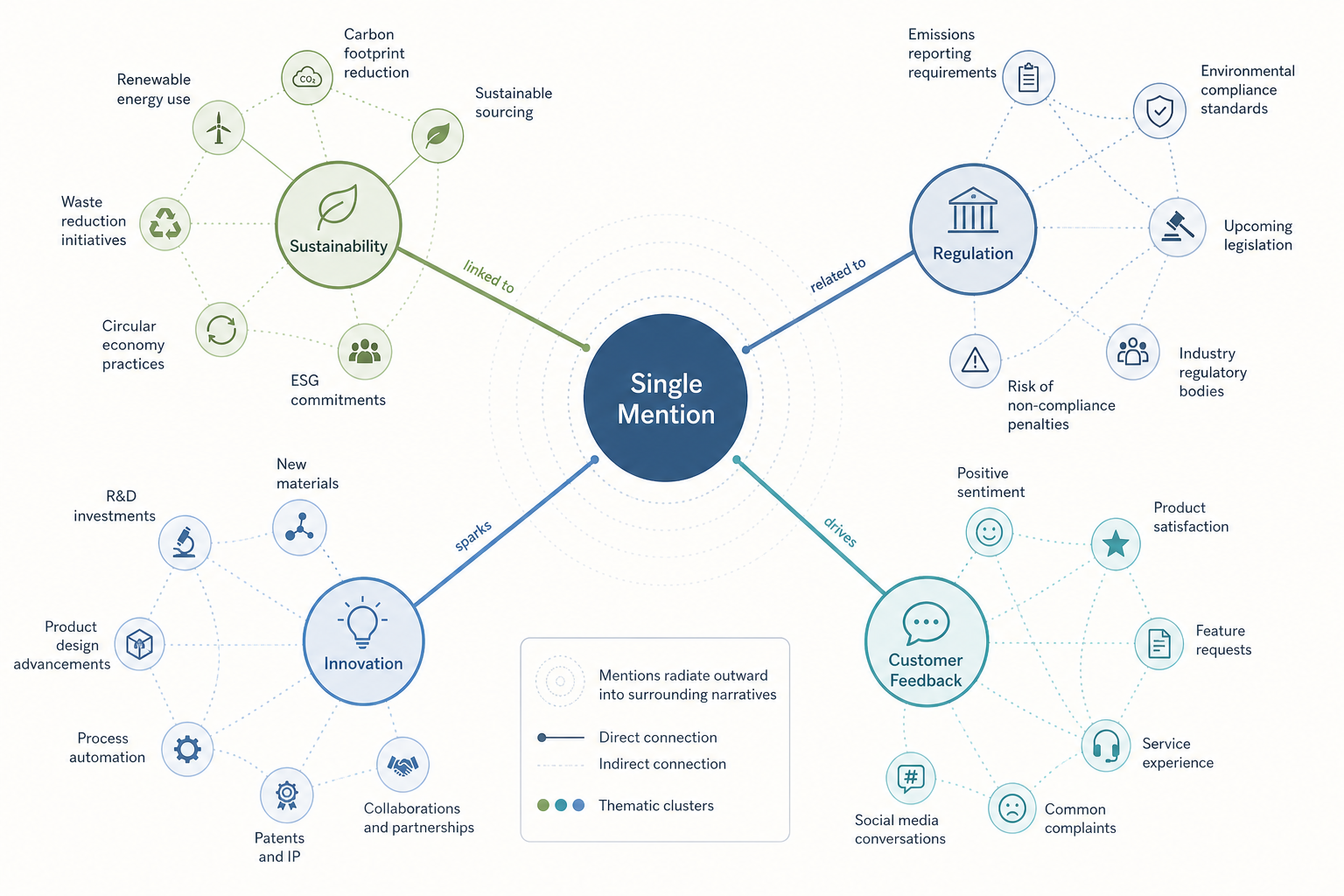
How Topic Analysis Links Brand Mentions to Themes and Narratives in Media Intelligence
Brand mentions become narrative intelligence through topic analysis
Understand how media intelligence platforms link what is said about your brand to the themes and stories shaping public perception.
Turn brand mentions into actionable narrative intelligence
Discover how topic analysis transforms a raw brand mention into a window on the narrative surrounding it, and what that means for your media intelligence workflow.
Counting mentions is not the same as understanding them
A brand mention tells you that your name appeared somewhere. It does not tell you whether that appearance was in a story about innovation, a crisis narrative, a competitor comparison, or an industry trend. Raw mention volume is a starting point, not an insight. Media intelligence goes further by analyzing the data for trends, sentiment, context, and strategic value, rather than simply logging that a mention occurred.
Topic analysis is the capability that bridges this gap. It examines the words, entities, and themes surrounding each mention and asks: what is this coverage actually about? The answer is what transforms a count into context. For communications professionals evaluating their current tools, the practical question is whether those tools can tell them not just how often a brand appeared, but what conversation it appeared inside. If they cannot, a significant share of the intelligence value is being left on the table. Platforms that offer genuine brand monitoring surface this layer of context as a core feature, not an add-on.
How clustering connects a mention to its surrounding narrative
Topic clustering works by grouping content according to semantic similarity rather than keyword overlap. Algorithms scan large volumes of text and automatically group words and documents into topics based on patterns of word usage. Common approaches include LDA (Latent Dirichlet Allocation), NMF (Non-negative Matrix Factorization), and BERTopic, each of which infers thematic structure from the language itself rather than from predefined categories.
When a brand mention appears inside a cluster, the platform can read the cluster's dominant theme and attach it to that mention. This is how a mention in a podcast episode about electric vehicle infrastructure gets tagged as part of a sustainability narrative, even if the word "sustainability" never appears in the same sentence as the brand name. Entity-level context means the platform understands what the mention is adjacent to, not just what it contains.
This is also where entity recognition becomes critical. A platform that can correctly identify a brand name even when it is abbreviated, mispronounced, or spoken ambiguously can then place that entity accurately within the right thematic cluster, rather than losing it to noise or misclassification. The result is a map of which themes each brand is consistently appearing alongside, across every source the platform monitors.
Managed narratives, emergent narratives, and why the difference matters
Not every narrative surrounding a brand is one the brand chose. Narrative clustering distinguishes between managed brand narratives, those driven by campaigns and official communications, and emergent community narratives, which arise organically from audience conversation, media framing, or crisis events. Understanding which type of narrative a mention belongs to changes how a communications team should respond.
A brand appearing repeatedly in coverage about supply chain disruption is inside an emergent narrative it did not create. A brand appearing in coverage about its own product launch is inside a managed narrative it controls. Topic analysis makes this distinction visible at scale, across hundreds of sources simultaneously, in a way that manual review cannot.
For competitive intelligence, the same logic applies. When a competitor's name clusters consistently alongside themes of regulatory scrutiny or customer complaints, that pattern carries strategic meaning. Sentiment analysis layered on top of topic clusters adds another dimension: not just what the narrative is about, but whether the tone around a brand within that narrative is positive, neutral, or negative. Together, topic and sentiment give a far sharper picture of competitive positioning than share of voice alone. Teams that want to measure that positioning rigorously can find practical guidance on how to measure share of voice.
Detecting emerging stories before they become headlines
One of the most practically valuable applications of topic analysis is early detection. By analyzing which topics are growing in volume over a given time period, organizations can spot emerging stories and shifting public narratives before they reach mainstream coverage. A cluster that is small today but accelerating in mention volume is a signal worth investigating, even if no individual mention within it seems significant on its own.
At scale, this kind of detection is only possible with automation. When a brand generates hundreds of thousands of mentions a month, manual review is not feasible. AI-driven topic clustering surfaces the patterns that matter: a sudden grouping of mentions around a product feature, a new association forming between a brand and a policy debate, or a competitor narrative gaining traction in audio media before it appears in print.
Platforms like Tonar extend this capability into audio and video, where broadcast monitoring and podcast transcription create a structured, searchable record of spoken content. Because audio is transcribed before analysis, topic clustering can be applied to radio, podcast, and streaming coverage with the same precision as text. For teams building or evaluating their toolkit, a comparison of media monitoring software options can help clarify which platforms genuinely offer this depth of topic intelligence.
Knowing your brand was mentioned is the beginning; knowing it was mentioned in the context of a crisis narrative, a sustainability story, or a competitor comparison is where the intelligence actually starts.
Benefits
Richer context around every mention
Topic analysis tells you not just that your brand was mentioned, but what story that mention was part of. A mention inside a crisis narrative and a mention inside a product innovation story carry completely different strategic implications, and topic-linked intelligence makes that distinction explicit.
Faster detection of emerging narratives
Topic clusters that are growing in volume signal emerging stories before they reach mainstream coverage. Detecting a narrative shift early, whether it concerns your brand or a competitor, gives communications teams time to respond rather than react.
Sharper competitive benchmarking
When competitor mentions are mapped to topic clusters, patterns of association become visible at scale. A competitor consistently appearing alongside themes of regulatory scrutiny or customer friction is a competitive signal that raw share-of-voice data alone would not surface.
Less noise from irrelevant mentions
Topic clustering filters out mentions that share a brand name but belong to entirely unrelated conversations. Grouping by semantic context rather than keyword match means the mentions that reach an analyst's attention are the ones that are genuinely relevant to the brand's media narrative.
Topic analysis in practice
A PR team tracks a sustainability narrative across podcasts
A communications team at a consumer goods brand notices through their media intelligence platform that their brand is appearing with increasing frequency inside a sustainability-themed topic cluster across Nordic podcasts. The mentions are not all positive, and none were prompted by a campaign. Topic analysis reveals the emergent narrative before it surfaces in mainstream press, giving the team time to assess whether a proactive response is warranted. Without topic clustering, these mentions would have appeared as individual data points with no visible connection to each other or to the broader story forming around them. The team uses sentiment analysis alongside the topic data to assess the tone of the narrative and prioritize their response.
A competitive intelligence team spots a reputational shift
A competitive intelligence team monitoring a rival brand notices that its mentions are increasingly clustering around themes of pricing pressure and customer dissatisfaction, even though the competitor has not made any public announcements. The topic cluster forms from organic media and podcast coverage, not from any single source. The team is able to document the emerging narrative, track its growth in volume, and factor it into their own positioning strategy. This kind of insight is not available from raw mention counts or keyword alerts alone. For teams building a systematic approach to this kind of analysis, resources on PR analytics tools can help identify platforms with the right depth of topic intelligence.
An agency team audits topic associations for a new client
An agency team onboarding a new brand client runs a retrospective topic analysis across the past several months of media coverage. The analysis reveals that the brand has been consistently appearing inside clusters related to a regulatory debate it has no direct involvement in, simply because of proximity to other entities in the same industry segment. This unintended topic association is invisible to keyword monitoring but immediately visible in a topic-clustered view of the brand's media footprint. The team uses this finding to advise the client on messaging adjustments and to set baseline benchmarks for tracking how the association evolves. Custom labeling capabilities, such as Auto-label, allow the team to flag and monitor these specific clusters going forward.
How topic analysis links brand mentions to themes: common questions
See what narratives are forming around your brand in Nordic media
Topic analysis is the layer of media intelligence that turns a list of brand mentions into a map of the narratives your brand is living inside. If your current monitoring tools stop at the mention, it is worth understanding what a topic-linked view of your coverage would reveal. Explore what Tonar's topic analysis and entity recognition capabilities look like in practice.