
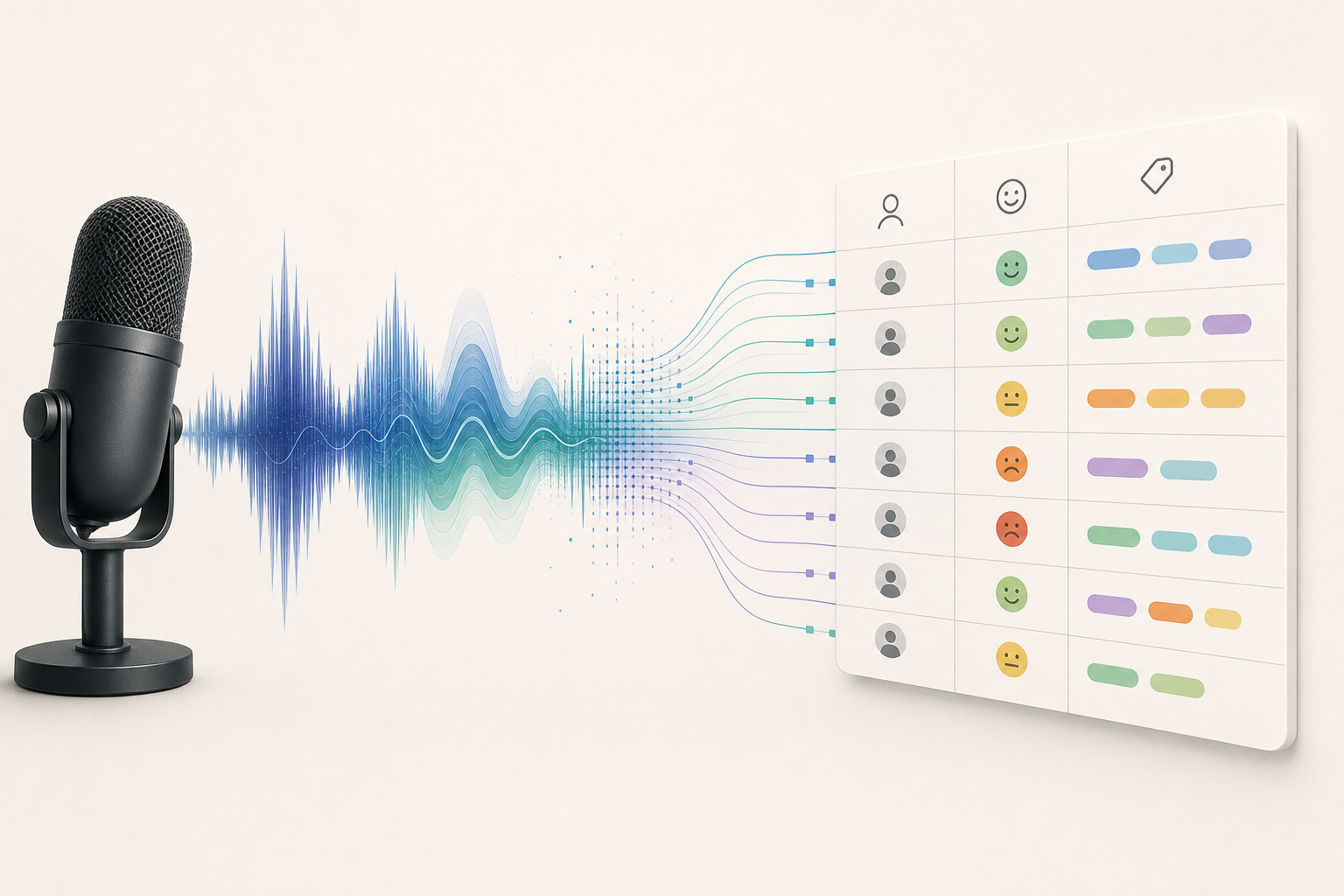
How to Extract Structured Brand Intelligence from Podcast Content
Turn raw podcast audio into structured brand intelligence
A practical framework covering transcription, entity extraction, sentiment analysis, and share-of-voice reporting.
Build a podcast brand intelligence pipeline that works
Discover how to build a reliable pipeline from podcast audio to actionable brand data, step by step.
Podcasts are a growing intelligence blind spot
Podcast listenership has grown steadily across the Nordic region, and with it the volume of brand mentions, competitive commentary, and industry opinion buried inside audio files that most monitoring stacks never touch. Unlike press releases or news articles, podcast content is not indexed by default. A host can spend ten minutes discussing your brand, your competitors, or your category, and your media monitoring dashboard will show nothing.
This is the core problem: podcasts are a massive, growing media channel, but the intelligence inside them remains unstructured and invisible unless you deliberately build a pipeline to surface it. The brands that treat podcasts as searchable data rather than background noise are the ones that will catch reputation shifts, competitive moves, and sponsorship opportunities before they become obvious.
Transcription quality sets the ceiling for everything downstream
Every downstream step, entity extraction, sentiment scoring, share-of-voice measurement, depends entirely on the quality of the transcript. Automated transcription accuracy runs 85 to 92 percent depending on the service, which is acceptable for searchability but punishing for brand intelligence: a mis-transcribed company name breaks the entity recognition model before it even starts.
Nordic languages add a further layer of difficulty. Swedish, Finnish, and Norwegian each carry dialects, compound nouns, and pronunciation patterns that generic speech recognition models handle poorly. A model trained on English-dominant data will routinely mis-transcribe Nordic brand names, abbreviations, and proper nouns. Word error rate is the single most important benchmark to interrogate when evaluating any transcription layer, because errors compound at every subsequent stage of the pipeline. Tonar's proprietary models, trained specifically on Nordic-language broadcasts, achieve a claimed word error rate of 3%, which is materially lower than open-source alternatives.
Entity extraction turns text into structured brand data
Once you have a reliable transcript, the next task is parsing it into structured entities: company names, executive identities, product references, competitive mentions, and strategic topics. This is entity recognition in practice, and it is harder than it sounds. A brand may appear as a full legal name, a common abbreviation, a ticker symbol, or even a mispronunciation, and a robust system must resolve all of these to the same canonical entity.
The richest systems go further. Every transcript can be parsed into a network of entities linked by co-mention frequency, so you can see not just that your brand was mentioned, but which competitors, topics, and people appeared alongside it. That co-mention graph is where competitive intelligence actually lives. Entity resolution also requires domain verification: confirming that "Apple" in a food podcast refers to the fruit, not the technology company, is a context problem that keyword matching alone cannot solve.
Sentiment analysis must work at the entity level, not the episode level
Episode-level sentiment is almost useless for brand intelligence. A single podcast episode might praise one brand, criticise a competitor, and discuss an industry trend neutrally, all in the same conversation. Scoring the episode as "positive" or "negative" collapses that nuance into noise.
Entity-level sentiment scores each mention individually, evaluating the tone of the specific passage in which a brand appears rather than the overall episode. Context is everything here: "We dropped Brand X from our stack" and "Brand X sponsors this episode" are both mentions, but they carry opposite meaning for brand intelligence purposes. More advanced approaches use models that can track how sentiment shifts across the arc of a long interview or panel discussion, capturing changes in tone that a static score would miss. Tonar's sentiment analysis evaluates tone at the entity level, which is the right unit of analysis for brand monitoring and reputation tracking.
Share of voice and sponsorship detection close the loop
With entities extracted and sentiment scored, the final layer is aggregation: turning individual mention data into comparative metrics. Share of voice measures how often your brand appears relative to competitors across a defined corpus of podcast content, and it is the metric that makes podcast intelligence comparable to traditional media monitoring. See how to measure share of voice for a fuller treatment of the methodology.
Sponsorship and advertiser mention detection adds a separate but related dimension. A brand mention that occurs inside a clearly marked ad read carries different weight than an organic editorial mention, and a rigorous pipeline distinguishes between the two. Verification of what actually aired, rather than what was contracted, is a practical use case for sponsorship tracking teams. Combining organic mention volume, sentiment, and paid placement data gives communications and marketing teams a complete picture of how their brand is represented across the podcast landscape, not just a keyword count.
The brands that treat podcasts as searchable data, not background noise, will catch reputation shifts and competitive moves before they become obvious.
From raw audio to brand intelligence: the five-step pipeline
- 1
Ingest and index podcast audio
The pipeline starts with systematic audio ingestion across your target podcast corpus. This means connecting to podcast feeds, streaming platforms, and broadcast archives so that new episodes are captured automatically as they publish. Coverage scope matters as much as processing quality: a pipeline that misses episodes creates gaps in your share-of-voice data. Define which shows, channels, and platforms are in scope before you build, and confirm that your ingestion layer handles the audio formats and delivery mechanisms each source uses.
- 2
Transcribe with a high-accuracy ASR model
Automatic speech recognition (ASR) converts the audio into text. At this stage, word error rate is the metric to optimise: errors in the transcript propagate through every downstream step. For Nordic-language content, use a model trained on the specific languages and dialects in your corpus rather than a generic multilingual model. Timestamp alignment, which maps each word back to its position in the audio, is essential so that users can later verify any mention by listening to the original clip.
- 3
Extract and resolve named entities
Run the transcript through an entity recognition layer that identifies company names, people, products, and topics, then resolves each to a canonical form. Resolution handles abbreviations, alternate spellings, and mispronunciations. Co-mention mapping, which records which entities appear together in the same passage, adds a competitive intelligence dimension that simple keyword extraction cannot provide. Flag ambiguous entities for context-based disambiguation rather than discarding them.
- 4
Score sentiment at the entity level
Apply sentiment analysis to each individual entity mention rather than to the episode as a whole. The model should evaluate the specific passage surrounding each mention, not the overall episode tone. Classifying mentions by context, distinguishing organic editorial commentary from paid sponsorship reads, is a critical step here. A mention inside an ad read and a mention in a host's personal recommendation are both data points, but they belong in different analytical buckets.
- 5
Aggregate into share-of-voice reports
Combine mention volume, sentiment scores, and topic associations into structured outputs: share-of-voice dashboards, competitive benchmarks, and trend reports. Use auto-label rules to automatically tag mentions by campaign, product line, or business unit so that reports map onto the way your organisation actually works. Structured outputs are what separate brand intelligence from raw data: a list of mentions is a starting point; a share-of-voice trend broken down by sentiment and topic is something a communications director can act on. For a broader view of measurement methodology, see how to measure share of voice.
Benefits
Speed from audio to insight
Automated pipelines process new podcast episodes as they publish, delivering mention alerts and sentiment scores within hours rather than days. Timely intelligence means communications teams can respond to emerging narratives before they compound across other media channels.
Accuracy that holds at the entity level
Entity-level sentiment scoring and named-entity resolution produce intelligence that is specific enough to act on. Knowing which brand was mentioned, in what context, and with what tone is categorically more useful than a keyword count or an episode-level sentiment flag.
Competitive context built in
Co-mention mapping and share-of-voice aggregation place your brand's podcast presence in competitive context automatically. Seeing how your mention volume and sentiment compare to competitors across the same corpus of content is the kind of benchmarking that manual monitoring cannot scale to.
Structured outputs that teams can act on
Raw transcripts and keyword lists require human interpretation before they become decisions. Structured brand intelligence, with labelled mentions, sentiment scores, topic associations, and share-of-voice metrics, maps directly onto the reporting formats that PR managers, marketing directors, and agency clients already use.
Where structured podcast intelligence solves real problems
PR team tracking brand reputation across Nordic podcasts
A communications team at a Nordic consumer brand wants to know how their company is being discussed across the podcast landscape, not just in print and broadcast news. By running podcast audio through a structured pipeline, they receive timestamped mention alerts with entity-level sentiment scores, and can listen to the exact audio clip directly in the platform. Catching a negative editorial mention early, before it spreads to other media, gives the team time to respond rather than react. This is brand mention tracking applied to a channel that most PR stacks ignore entirely.
Competitive intelligence unit benchmarking share of voice
A competitive intelligence team at a B2B technology company wants to understand how their brand's presence in industry podcasts compares to three key competitors over a rolling period. Structured podcast data, with entity extraction and mention volume aggregated by brand, makes this comparison possible in a way that manual listening never could. Share-of-voice trends across podcast content reveal which competitors are gaining editorial momentum and which topics they are being associated with, informing both messaging strategy and content investment. Teams can use natural language search to surface specific competitive mentions by intent rather than exact keyword.
Agency verifying sponsorship delivery for a client
A media agency managing podcast sponsorship campaigns for a retail client needs to verify that contracted brand reads actually aired, and to assess the context in which the brand was mentioned. A structured pipeline with sponsorship detection distinguishes paid ad reads from organic mentions and confirms delivery with timestamped evidence. Verification of what actually aired, rather than relying on publisher reporting alone, gives the agency an independent audit trail. This data also feeds into broader PR analytics reporting, connecting sponsorship delivery to share-of-voice and sentiment trends.
Common questions about extracting brand intelligence from podcasts
Start treating podcast content as structured brand data
Podcast content is one of the fastest-growing sources of brand mentions in Nordic media, and most monitoring stacks miss it entirely. If you want to understand how Tonar turns audio into structured brand intelligence across Swedish, Finnish, and Norwegian podcasts, the platform is worth a closer look.