
How Audio Intelligence Platforms Turn Unstructured Broadcast Audio into Structured Data
Raw broadcast audio becomes structured brand intelligence: here is how
From speech to searchable data: the full pipeline that turns Nordic radio, podcasts and streaming into actionable insight.
Turn broadcast audio into structured, queryable brand data
Understand the pipeline from unstructured broadcast audio to structured brand data, and know what to look for in a platform.
The audio blind spot most organisations carry
Across Sweden, Norway, Finland and Denmark, enormous volumes of content are produced every day: morning radio, news broadcasts, financial podcasts, streaming debate shows, short-form clips. Almost none of it is searchable. Almost none of it is measurable. It exists as audio, which means it is invisible to the tools most communications and PR teams rely on.
Text-based monitoring captures press releases, articles and social posts. It misses the interview where a journalist frames your organisation negatively, the podcast episode where a competitor is praised, and the radio segment where a policy you care about is discussed at length. The audio layer is where reputational risk often starts and spreads, long before it reaches the written press. Organisations that do not monitor it are working with an incomplete picture of their own coverage, and they usually do not know what they are missing.
Why speech-to-text accuracy is the foundation everything else rests on
Every downstream insight, every entity, every sentiment score, depends on the quality of the transcript. If the transcript is wrong, the entity extraction is wrong. If the entity extraction is wrong, the sentiment is attached to the wrong subject. The whole pipeline degrades.
General-purpose transcription models are trained predominantly on English and major European languages. Nordic languages, with their compound words, distinct dialects and broadcast-specific vocabulary, are an afterthought for most. The result is high error rates on exactly the names, organisations and topics that matter most for brand monitoring.
Tonar's proprietary speech models are trained on Nordic languages, dialects and real broadcast material, reaching a word error rate of 3%. That is a meaningful gap from open-source alternatives. For a communications team, the difference between a 3% error rate and a 10% error rate is the difference between reliable intelligence and a system that routinely misidentifies the brand being discussed. Accuracy benchmarks for AI transcription vary widely across languages, and Nordic performance is where general-purpose platforms tend to fall short.
Entity extraction turns a transcript into a structured record
A transcript is text. Structured data is something you can query, aggregate, filter and route into a workflow. The step that bridges them is entity extraction: the process of identifying and labelling the people, organisations, locations, products and topics that appear in the text.
This sounds straightforward, but context is everything. "Apollo" as a private equity firm and "Apollo" as a space mission are different entities. A brand abbreviation that is obvious to a Nordic listener may be opaque to a general-purpose model. Mispronounced names, informal references and abbreviations all require the model to resolve ambiguity from context, not just pattern-matching on strings.
Tonar's entity recognition understands Nordic broadcast context, so brand names, abbreviations and people are identified correctly even when pronunciation is imperfect or the reference is indirect. Each detected entity links back to the original audio, so the reader can listen to exactly what was said rather than relying on the transcript alone. This is what separates brand mention tracking from a keyword alert.
Sentiment and criticality are not the same measurement
Most sentiment analysis counts positive and negative words. That produces a score, but not necessarily a useful one. A long, broadly neutral discussion of your organisation and a brief, sharply critical mention score very differently on a word-count model, but the brief critical mention may be far more consequential.
A more useful approach separates two dimensions: how deep a mention is (is the organisation the main subject, or a passing reference?) and how critical it is (does the mention express criticism, and of what kind?). Tonar's criticality score evaluates individual mentions for whether they are critical towards the organisation and how, rather than aggregating sentiment across a transcript. Sentiment is evaluated at entity level, not at document level, which means you know which organisation a sentiment attaches to, not just whether the programme was broadly positive.
For communications teams, this distinction matters. It is the difference between a dashboard number and an early warning. Explore how sentiment analysis works at entity level for a deeper look at the methodology.
APIs and structured output make the data usable across teams
Structured data only creates value when it flows to the people and systems that need it. A well-documented API is what separates a monitoring platform from a closed dashboard. When the full data set is accessible via API, media companies can embed audio intelligence into their own products, developers can build custom workflows, and product teams can surface brand mentions inside their existing tools.
Tonar exposes its complete data set through a REST API and RSS feed, covering transcripts, entities, sentiment, metadata, show and programme information, and criticality scores. Each mention carries the context needed to judge its weight: whether it is editorial or from the organisation's own channel, the depth of the mention, and the sentiment attached to the specific entity. Real-time delivery means a communications team can receive an alert within minutes of a mention airing, rather than discovering it in a weekly report. For teams evaluating platforms, the API's data model is worth scrutinising as carefully as the interface.
The gap between what is said on air and what organisations actually know about it is where reputational risk lives.
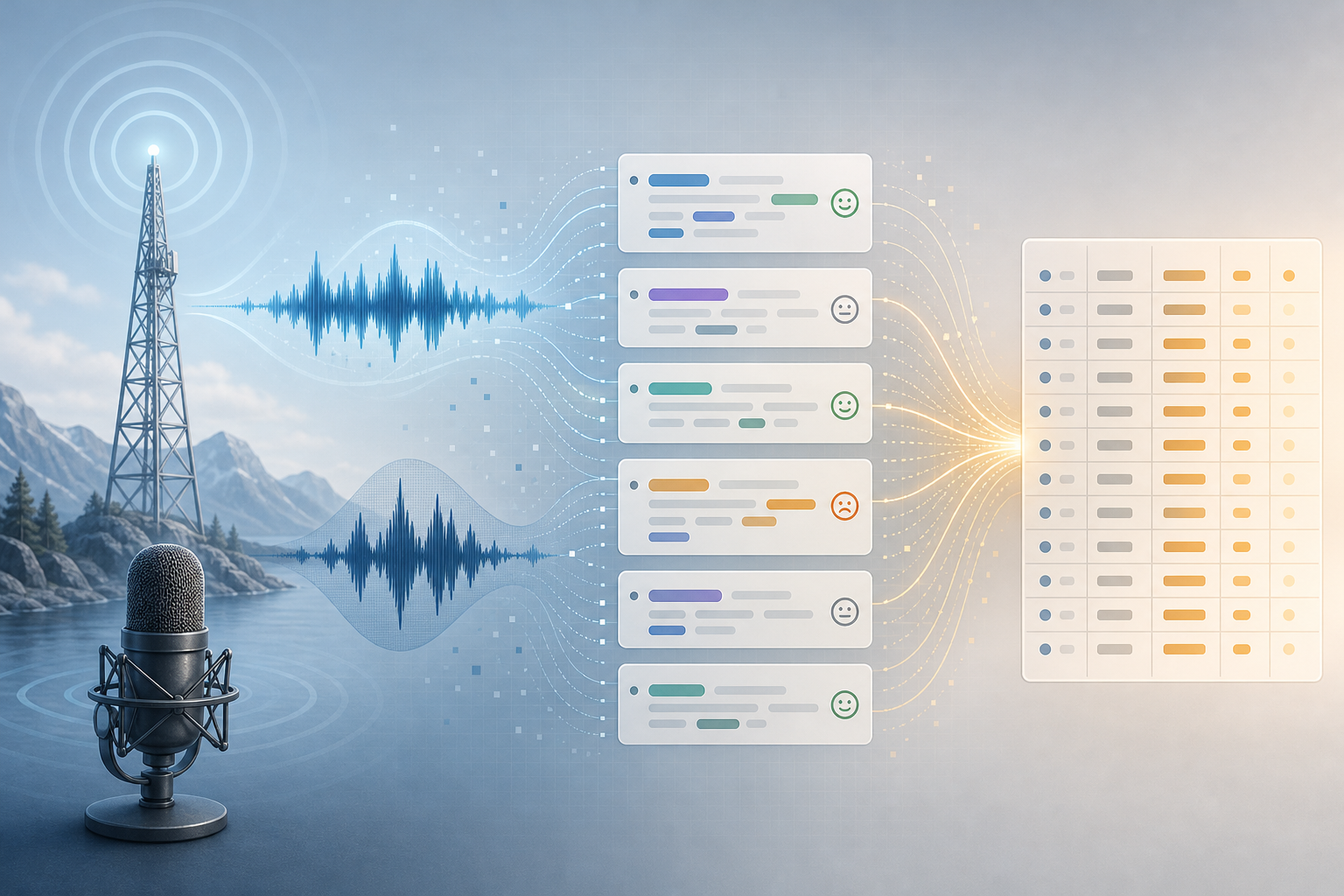
The pipeline from broadcast audio to structured data
- 1
Ingest audio from live and archived sources
The pipeline begins with continuous ingestion: live radio, television, podcasts, streaming services and short-form clips across Nordic broadcast channels. Every audio second is captured, whether it aired this morning or sits in an archive. The platform handles the logistics of source coverage so the customer does not need to manage feeds manually. Show and programme metadata is attached at this stage, recording where the content came from and what kind of channel it is.
- 2
Transcribe with Nordic-tuned speech models
Raw audio is passed through speech-to-text models trained specifically on Nordic languages, dialects and broadcast vocabulary. This is the foundation layer: every downstream analysis depends on transcript quality. Tonar's models reach a word error rate of 3%, which matters most for the names, organisations and topic-specific terms that are most likely to be mispronounced or ambiguous in general-purpose models. The output is timestamped, speaker-attributed text that can be linked back to the exact moment in the audio.
- 3
Extract and link entities in context
Entity extraction runs across the transcript, identifying and labelling organisations, people, locations, topics and other relevant entities. Crucially, this step resolves ambiguity from context: the same word can refer to different entities depending on the surrounding conversation. Each entity is linked to the source audio, so a reader can click through to hear exactly what was said rather than relying solely on the transcript. This is the step that turns a text document into a structured record you can query and aggregate. Natural language search then allows retrieval by intent rather than exact keyword.
- 4
Enrich with sentiment, criticality and depth scoring
Each mention is enriched with multiple layers of analysis. Sentiment is evaluated at entity level, not at document level, so the score attaches to the organisation being discussed, not to the programme as a whole. A criticality score identifies whether a mention is critical towards the organisation and in what way, which is a sharper signal than broad positive-or-negative sentiment. Depth scoring separates mentions where the organisation is the main subject from passing references. Together, these fields let a communications team prioritise what to read and what to act on.
- 5
Deliver structured data via app, briefs and API
The enriched, structured records are delivered through three routes. The app surfaces monitors with summaries of what has happened since the customer last looked. Weekly or monthly briefs summarise the main patterns and most important mentions for the period, ready to share across the organisation. The REST API and RSS feed expose the full data set for integration into dashboards, workflows and third-party products. Every field, from transcript text to entity metadata to criticality score, is accessible programmatically, making it possible to build brand monitoring into existing tools rather than maintaining a separate system.
Benefits
Coverage of the audio layer text tools miss
Radio, podcasts and streaming are where conversations about organisations often start, before they reach written press. Audio intelligence platforms monitor this layer continuously, giving communications teams visibility into a medium that text-only monitoring leaves entirely dark.
Early warning on reputational risk
Entity-level criticality scoring means a damaging mention is flagged as soon as it airs, not when it has already spread. The gap between a mention airing and a team becoming aware of it is where reputational risk compounds; structured audio data closes that gap.
Competitive context that is actually comparable
When every mention is a structured record with entity, depth, sentiment and channel metadata attached, share of voice and favourability comparisons become meaningful. Peer benchmarking on your own dimensions is only possible when the underlying data is structured consistently across all monitored entities.
Data that flows into existing workflows
A REST API with a full data model means audio intelligence does not stay locked inside a single dashboard. Transcripts, entities, sentiment and metadata can be routed into the tools a team already uses, from CRM systems to editorial platforms to custom dashboards built by a developer team.
Where structured audio data solves a real problem
A comms team catches a critical mention early
A communications team at a large Nordic organisation monitors their brand across radio and podcasts. A regional morning radio programme carries a critical interview about the organisation's handling of a recent issue. Without audio monitoring, this mention would not surface until a journalist followed up in print, hours or days later. With real-time entity-level criticality scoring, the team receives an alert within minutes of the segment airing, reviews the linked audio to hear exactly what was said, and prepares a response before the story spreads. This is the early-warning use case that audio intelligence is built for.
A public affairs team tracks a policy debate across channels
A public affairs team wants to follow how a specific regulatory debate is developing across Nordic broadcast media: which perspectives are being put forward, which voices are driving the conversation, and how the framing shifts over time. Rather than building Boolean search strings, the team describes the topic in plain language and Tonar finds all relevant content. Mentions are categorised according to the team's own way of breaking down the issue, making it possible to see, for example, whether industry voices or NGO voices are dominating the debate on a given week. This kind of structured topic tracking is not possible with text monitoring alone.
An agency benchmarks client coverage against peers
A PR agency manages several clients in the same sector and needs to show each client how their broadcast coverage compares to competitors. Structured audio data makes this possible: every mention carries entity metadata, depth scoring and sentiment at entity level, so share of voice and favourability can be calculated across a defined peer group. The agency uses Tonar's competitor benchmarking to produce monthly briefs that show not just how often each organisation was mentioned, but whether those mentions were substantive and whether the organisation's own spokespeople were heard. See also how to measure share of voice for the methodology behind these comparisons.
A media company integrates audio intelligence via API
A Nordic media company wants to surface structured data about who and what is being discussed across its own broadcast archive, and embed that intelligence into its editorial tools. Rather than building speech-to-text and entity extraction from scratch, the team connects to Tonar's REST API. Transcripts, entity data, sentiment and metadata are returned in structured fields that feed directly into the company's existing content management and search systems. The API's full data model, including criticality scores and show metadata, means the media company can build features that general-purpose transcription services do not support. This is the developer and media-company use case that a well-documented API enables.
Questions about turning broadcast audio into structured data
Start monitoring Nordic broadcast audio with structured intelligence
If your organisation's brand is being discussed on Nordic radio, podcasts or streaming, the question is not whether audio monitoring is useful but whether you are currently missing it. Tonar monitors continuously, transcribes with Nordic-tuned models, and delivers structured data you can act on, through the app, via briefs, or through the API.