
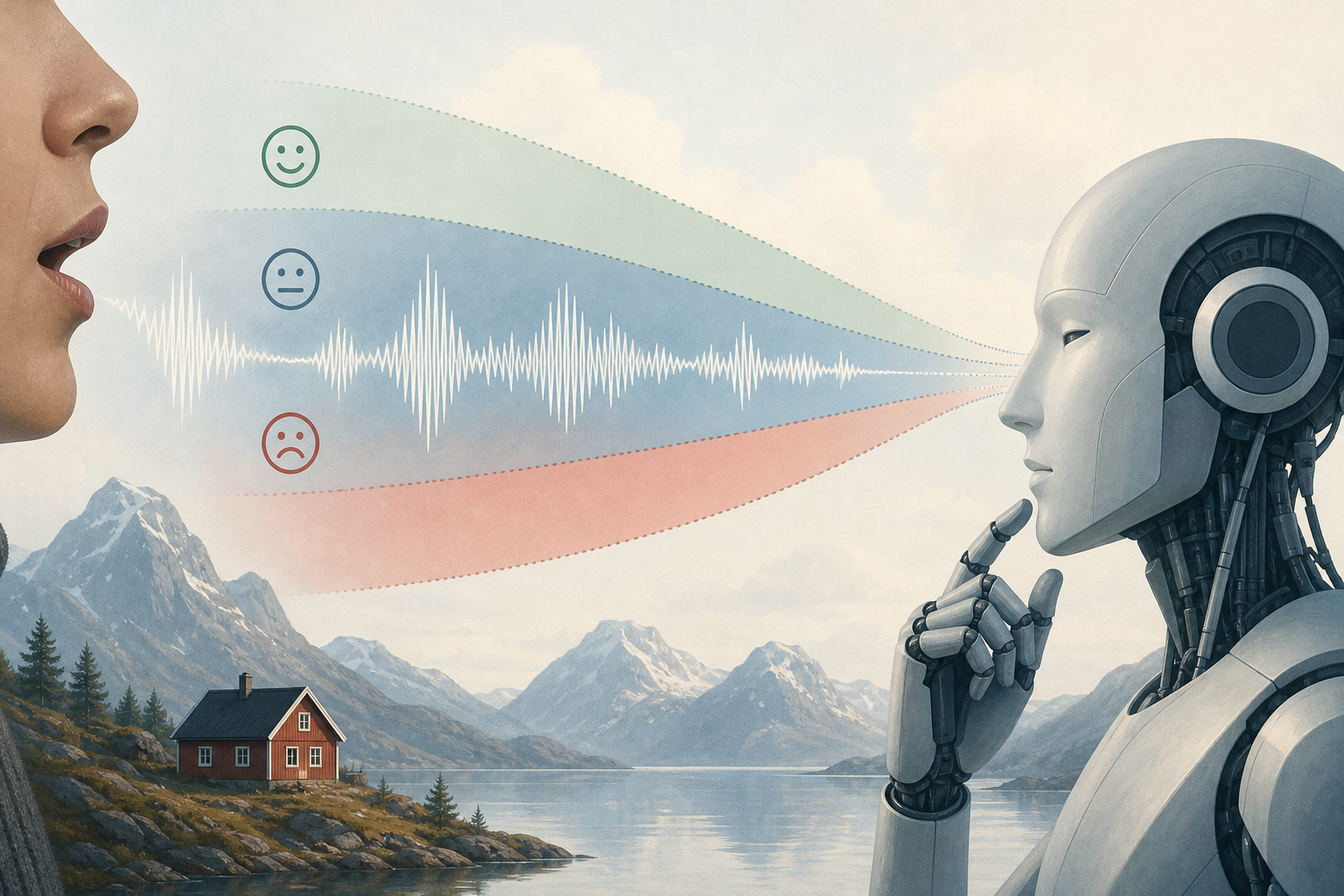
Best Sentiment Analysis Software
Sentiment analysis software: what actually separates the good from the good enough
A buyer's guide to accuracy, language coverage, and the audio gap most tools quietly ignore.
See Tonar's sentiment analysis in action
Explore how Tonar's audio-native sentiment engine handles Nordic media that text-based tools miss entirely.
Why sentiment accuracy is harder to achieve than vendors admit
Sentiment analysis software uses natural language processing and machine learning to classify the emotional tone of content as positive, negative, or neutral, and sometimes to detect more granular emotions like anger, joy, or frustration. The category sounds well-solved, but accuracy is more conditional than most vendor claims suggest. Advanced platforms typically achieve 70 to 85 percent accuracy on sentiment classification, and that range holds even for tools built on modern transformer architectures. The drop-off comes on live, sarcastic, or multi-topic text, which is exactly the content that matters most in real monitoring. Sarcasm detection remains one of the hardest open challenges in the field, and no major tool claims to have solved it. What separates genuinely useful tools from merely capable ones is how gracefully they degrade on the hard cases, and how honestly their vendors describe that degradation. Buyers should treat headline accuracy figures as a starting point, not a guarantee.
The evaluation criteria that actually differentiate tools
Beyond headline accuracy, four criteria separate tools worth buying from tools worth avoiding. First, language-specific performance: a model that is sharp in English and shaky in Swedish, Finnish, or Norwegian is a real and common gap. Ask vendors for accuracy figures in the specific languages your audience uses. Second, domain fit: sentiment tools trained on data from the relevant industry domain consistently outperform general-purpose models on domain-specific vocabulary. Third, the level of analysis: aspect-based sentiment, which breaks overall brand sentiment into specific categories like product quality or customer support, is far more actionable than a single positive/negative label. Fourth, the data source: most tools are built for text, covering social media posts, reviews, and CRM notes. If your brand is discussed on radio, podcasts, or streaming platforms, a text-only tool is structurally blind to that conversation. That gap is where the comparison between tools like Brandwatch and Tonar becomes most consequential. For a broader look at how sentiment fits into a full monitoring stack, see how to choose a media monitoring platform.
Brandwatch: what it does well and where it stops
Brandwatch is one of the most established names in social listening and consumer intelligence. Its sentiment engine uses transformer-based language models to classify mentions as positive, negative, or neutral, and it extends to six-emotion detection, emoji sentiment analysis, and image analytics including logo recognition. The platform supports sentiment in over 40 evaluated languages and is pre-trained on billions of words, making it a credible choice for large enterprises tracking brand perception across global social media. Its accuracy for most queries in a supported language is estimated at 60 to 75 percent, and it has invested in contextual models to improve handling of sarcasm, though it does not claim perfect detection there. Brandwatch is a strong fit for marketing and insight teams that need broad social data coverage, competitive benchmarking, and customizable dashboards across text-based channels. Where it stops: Brandwatch is built for text. Radio, podcasts, and broadcast media are outside its scope. For brands operating in the Nordic market, where audio media carries significant share of public conversation, that is a structural limitation no dashboard feature can compensate for. Teams evaluating the best brand monitoring tools should weigh this channel gap carefully.
Where Tonar fits and who it is genuinely built for
Tonar approaches sentiment from the audio side first. The platform continuously transcribes podcasts, radio broadcasts, streaming content, and social video across the Nordic market, using proprietary AI models trained specifically on Swedish, Finnish, and Norwegian dialects. That 3% word error rate on Nordic-language audio is the foundation everything else rests on: cleaner transcription produces more reliable sentiment, because a model classifying tone in a garbled transcript is classifying noise. From that transcription base, Tonar performs entity-level sentiment analysis, meaning it evaluates the tone directed at a specific brand, person, or topic within a segment, rather than labeling the whole clip. It also maps which topics are associated with which brands in media conversations, adding a layer of context that polarity scores alone cannot provide. For PR teams, communications directors, and competitive intelligence professionals who need to know how their brand is being discussed on Nordic radio and podcasts, not just on social media, Tonar covers ground that text-based tools like Brandwatch structurally cannot. Teams that primarily need global social media sentiment at scale will still find Brandwatch the more complete fit. For anyone whose monitoring scope includes audio media in Sweden, Finland, or Norway, Tonar is the more honest choice. Explore sentiment analysis and entity recognition in more detail.
Brandwatch vs Tonar: which fits your monitoring scope
Both platforms offer sentiment analysis, but they are built for different channels and different markets.
- Brandwatch
- Best suited to large enterprise teams that need broad global social listening, six-emotion detection, and competitive benchmarking across text-based channels.Transformer-based sentiment across 40+ evaluated languages; focused on social media, reviews, and text content.
- Tonar
- Best suited to PR teams, communications directors, and competitive intelligence professionals who need entity-level sentiment across Nordic radio, podcasts, and streaming media.Audio-native, Nordic-language models with 3% word error rate; entity-level sentiment and topic linking across broadcast sources.
Choose Brandwatch if your primary need is global social media sentiment at scale across text channels. Choose Tonar if your monitoring scope includes Nordic audio and video media and you need sentiment that goes beyond what any text-based tool can reach.
Sentiment classification is only as reliable as the transcription it runs on, and that is the gap most text-based tools never have to confront.
Benefits
Audio-native transcription feeds cleaner sentiment
Tonar's proprietary models achieve a claimed 3% word error rate on Nordic-language audio, significantly below open-source alternatives. Sentiment classification is only as reliable as the text it runs on, so fewer transcription errors translate directly into more trustworthy tone signals.
Entity-level tone, not keyword polarity
Rather than labeling an entire clip or article as positive or negative, Tonar evaluates sentiment at the entity level, identifying the tone directed specifically at a named brand, competitor, or person within a segment. This distinction matters when a single broadcast discusses multiple brands with different tones.
Nordic language and dialect coverage by design
The underlying models are trained on real Nordic broadcasts in Swedish, Finnish, and Norwegian, including regional dialects and colloquial speech. Language-specific training is a known driver of sentiment accuracy, and most global platforms do not invest in Nordic audio at this depth.
Topic linking adds context to sentiment scores
Tonar's topic-linking feature maps which subjects are associated with which brands in media conversations, so a communications team can see not just that sentiment dipped, but which topics drove the shift. That context is what turns a sentiment score into an actionable brief.
Audio coverage that text tools structurally miss
Radio and podcast conversations about a brand are invisible to text-only sentiment platforms. Tonar monitors these channels continuously, meaning PR and marketing teams get a complete picture of brand perception across the Nordic media landscape, not just the portion that happens in writing.
Who benefits most from audio-native sentiment analysis
PR team tracking brand sentiment across Nordic radio
A communications team at a mid-sized Nordic consumer brand needs to know how their company is being discussed on radio news and talk shows, not just on social media. Text-based sentiment tools return nothing for broadcast content. Tonar continuously transcribes and analyzes those broadcasts, surfacing entity-level sentiment for each brand mention so the team can respond to negative coverage before it compounds. The brand mention tracking layer means no mention goes undetected, even when the brand name is abbreviated or mispronounced.
Marketing director benchmarking share-of-voice sentiment against competitors
A marketing director wants to understand not just how often their brand appears in Nordic podcast coverage, but whether the tone of those mentions is more positive than competitors. Tonar's competitor benchmarking and sentiment analysis run in parallel, so the director can compare share of voice alongside sentiment trajectory across the same set of audio sources. This is the kind of competitive intelligence that informs positioning decisions, not just reporting. See also how to measure share of voice.
Agency reporting sentiment trends for multiple brand clients
A PR agency managing media analysis for several Nordic clients needs to deliver consistent sentiment reporting across radio, podcast, and streaming coverage each month. Tonar's auto-label feature lets the agency define custom tagging rules in plain language so the platform automatically categorizes mentions by client, topic, and tone. Automated labeling at this level removes manual triage from the workflow, making it realistic to run sentiment reporting across a portfolio of clients without scaling headcount.
Developer team embedding sentiment data into a media dashboard
A media company wants to enrich its internal analytics dashboard with real-time sentiment signals from Nordic broadcasts, without building its own transcription and NLP pipeline from scratch. Tonar exposes its full data set through a well-documented API, including a full database firehose, REST API, and RSS feed. The development team can pull entity-level sentiment, transcription data, and topic associations directly into their own product, reducing the build cost significantly. This is a distinct use case from social listening platforms, which typically do not offer this kind of audio data integration.
Common questions about sentiment analysis software
Nordic audio sentiment coverage starts with the right tool
If your brand is discussed on Nordic radio, podcasts, or streaming platforms, a text-only sentiment tool is structurally blind to that conversation. Tonar is built specifically for that gap: audio-native, Nordic-language, and entity-level from the ground up. Reach out to see how it handles your actual media landscape.