
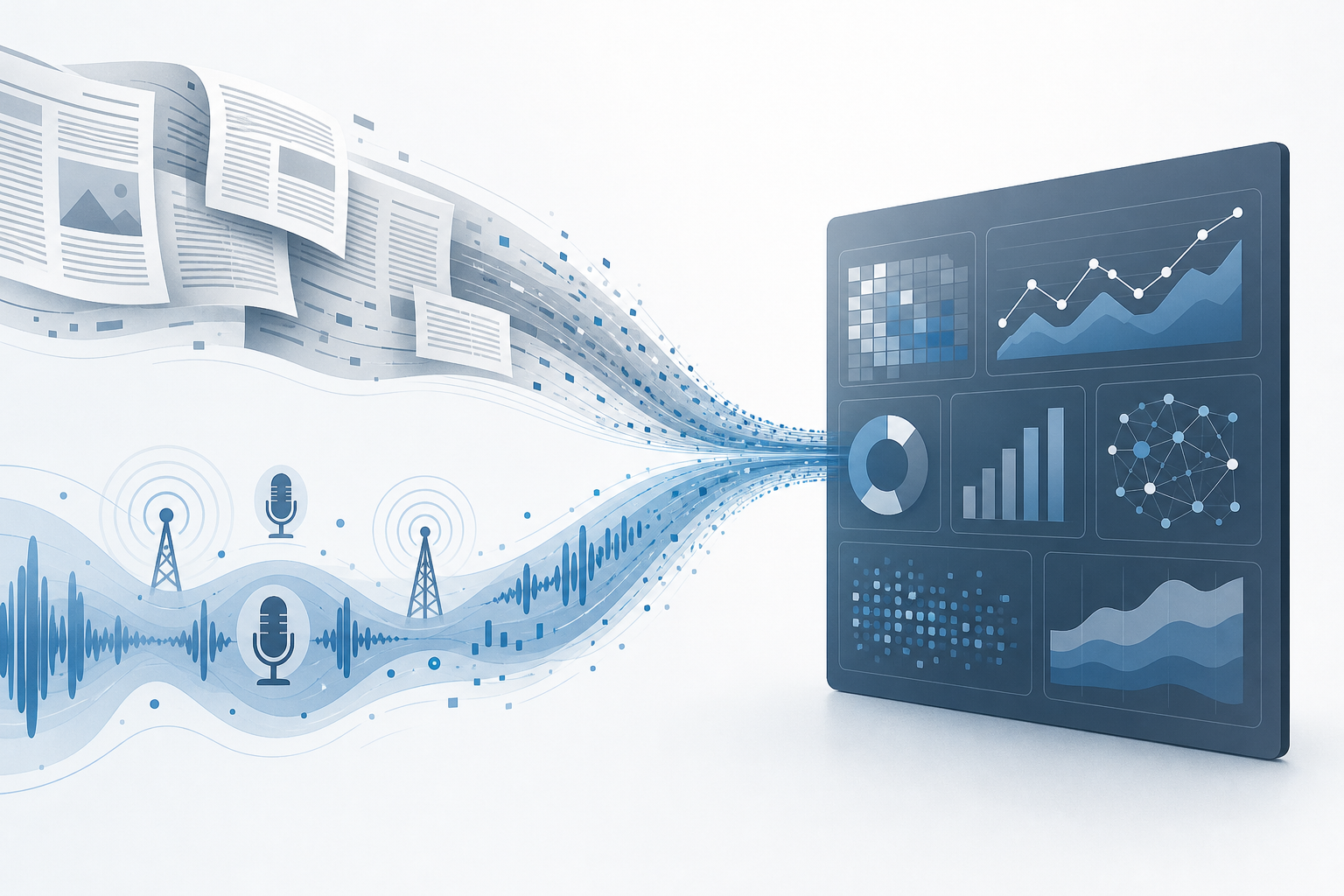
Audio Media Monitoring vs. Text-Based Media Monitoring: Benefits and Limitations
What text-based monitoring misses about audio and broadcast media
A clear-headed comparison of audio media monitoring vs. text-based monitoring: where each approach wins, and what your current stack might be leaving unheard.
Find the coverage gap in your current media monitoring
Discover whether your brand is being mentioned in podcasts, radio, and streaming content your text tools never reach.
Text-based monitoring is thorough, but bounded by what is already written
Text-based media monitoring works by crawling published content: news articles, press releases, blog posts, social media feeds, and online forums. It is fast, well-established, and genuinely good at surfacing brand mentions across the written web. For most communications teams, it forms the backbone of their daily media intelligence.
The boundary is structural. Text monitoring can only index content that exists as text. A newspaper article is immediately crawlable. A radio interview, a podcast episode, or a live broadcast segment is not, unless someone has manually transcribed it or the platform has published a written summary. In practice, the majority of broadcast and podcast content is never transcribed by the source, which means it is invisible to any tool that relies on text crawling alone.
For teams operating in markets where broadcast media carries significant editorial weight, that gap is not a minor inconvenience. It is a systematic blind spot. See our guide to best media monitoring services for a broader look at how monitoring tools differ by coverage type.
Audio monitoring converts speech into structured brand intelligence
Audio media monitoring addresses the gap by applying speech-to-text transcription continuously across broadcast, podcast, and streaming content. Rather than waiting for a journalist to publish an article, the system listens in real time, transcribes what is said, and then applies the same entity recognition, sentiment analysis, and mention tracking that text-based tools use on written content.
A broadcast monitoring platform should cover radio, TV, podcasts, and streaming platforms at a minimum. The most complete tools also index short-form video clips and social media audio and video, so that a brand mention on a podcast clip shared to social does not fall through the gap between monitoring categories.
The practical effect is that audio monitoring does not replace text monitoring: it extends the coverage surface. Broadcast media adheres to strict editorial standards and reaches audiences simultaneously during live transmission, creating shared cultural moments that social media consumption, which is asynchronous and fragmented, cannot replicate. A brand crisis that breaks on a morning radio programme will reach a large simultaneous audience before any written article is published. Broadcast monitoring tools built on real-time transcription are the only way to catch that.
Transcription accuracy is the variable that determines monitoring quality
The promise of audio monitoring depends entirely on how accurately the speech-to-text layer performs. The best speech-to-text models reach about 95 to 98% word accuracy on clean audio, but accuracy on accented and noisy audio typically drops to a range of 70 to 90%. In real-world conditions, average AI transcription platforms deliver roughly 62% accuracy, which is far below what brand monitoring requires.
Errors compound at scale. A brand name that is consistently misheared is consistently missed, and a sentiment signal attached to the wrong entity is worse than no signal at all. For Nordic-language content specifically, general-purpose engines trained primarily on English degrade noticeably when applied to Swedish, Finnish, or Norwegian broadcasts. Dialects, proper nouns, and the natural pace of broadcast speech all create failure points that a generic model was never trained to handle.
This is the core technical argument for language-specific AI models. Tonar's proprietary models are trained specifically on Nordic languages, dialects, and real-world broadcast audio, with a claimed word error rate of 3%. That figure matters not just for raw transcription but for every downstream insight: entity recognition, sentiment scoring, and share of voice measurement all inherit whatever accuracy the transcription layer delivers.
Where Retriever and Tonar serve different parts of the same need
Retriever is the Nordic region's leading provider of media intelligence, offering media monitoring, media archives, and media analysis in a single platform alongside social media monitoring and business intelligence. For organisations that need a broad, integrated view of Nordic media coverage, Retriever is a well-established choice with deep archival reach and a platform built around the full media intelligence workflow.
Retriever's offering centres on media monitoring and analysis across channels, with social media monitoring included. Where the comparison becomes relevant for audio-first teams is in the depth of real-time audio processing: continuous transcription of live radio, podcasts, and streaming content with language-specific AI, entity-level sentiment, and a full API for embedding audio data into custom dashboards.
Tonar is purpose-built for teams whose primary gap is audio and broadcast coverage in Nordic languages. If your current workflow already handles text and social well but leaves broadcast and podcast mentions untracked, Tonar fills that specific gap with AI models trained on the exact linguistic conditions of Nordic media. For teams that need a single platform covering the full range of media types with archival depth and integrated business intelligence, Retriever is the stronger fit. For teams building audio intelligence into their own products via API, or needing granular Nordic-language broadcast data, Tonar is the more focused tool. Explore how brand monitoring approaches differ across these platform types.
Audio monitoring vs. text-based monitoring: which fits your need
The right choice depends on where your current coverage gaps are and how deeply broadcast and podcast content features in your media landscape.
- Text-based monitoring (e.g. Retriever)
- Best suited to teams that need broad, integrated media intelligence across written news, online content, and social media, with archival depth and business intelligence in a single platform.Does not cover audio and broadcast content that has not been published as text.
- Tonar (audio and broadcast monitoring)
- Best suited to teams whose primary gap is broadcast, podcast, and streaming coverage in Nordic languages, or who need to embed real-time audio intelligence into their own products via API.Purpose-built for Nordic-language audio with entity-level sentiment and real-time transcription.
Choose Tonar if broadcast and podcast mentions are a meaningful part of your brand's media presence and your current stack leaves them untracked. Choose a platform like Retriever if you need a single integrated solution covering the full range of media types, archival content, and business intelligence in one place.
The brand crisis that breaks on morning radio reaches its audience before any article is written, and text monitoring will never see it.
Benefits
Complete share of voice picture
Text monitoring alone counts mentions in articles and social posts, but broadcast and podcast content often reaches larger simultaneous audiences than written coverage. Adding audio monitoring to your stack means share of voice figures reflect the full media landscape, not just the portion that happens to be published as text.
Nordic-language transcription accuracy
Generic speech-to-text engines trained primarily on English degrade on Swedish, Finnish, and Norwegian dialects. Tonar's AI models are trained specifically on Nordic-language broadcasts, achieving a claimed word error rate of 3%, which means brand names, people, and entities are correctly identified even when mispronounced or abbreviated in natural speech.
Real-time alerting on broadcast mentions
Broadcast media reaches audiences simultaneously during live transmission. Real-time transcription and alerting means a brand mention on live radio triggers a notification before the audience has finished listening, giving communications teams the response window that text monitoring, which depends on publication, cannot provide.
Sentiment analysis at the entity level
Sentence-level sentiment flags whether a piece of content is broadly positive or negative, but entity-level sentiment tells you whether the tone is directed at your brand specifically, versus a competitor mentioned in the same segment. Tonar's sentiment analysis evaluates tone at the entity level, reducing false signals from mixed-sentiment content.
API access to real-time audio data
Media companies and product teams building their own dashboards need structured audio data, not just a monitoring interface. Tonar's API exposes real-time transcription, entity data, and sentiment via a full database firehose, REST API, or RSS feed, enabling audio intelligence to be embedded directly into custom tools and workflows.
Where audio monitoring catches what text tools miss
Brand mentioned in a podcast interview
A communications manager at a mid-sized Nordic consumer brand runs daily text monitoring and receives no alerts on a given morning. That same morning, the brand's CEO was interviewed on a widely followed business podcast, where the host raised questions about the company's pricing strategy. The episode is never transcribed by the podcast platform, so no text crawler finds it. An audio monitoring platform that continuously transcribes podcast content would have flagged the mention within minutes, including the sentiment context around the pricing discussion. The team could have prepared a response before listeners began reacting on social media.
Competitor discussed on live radio
A competitive intelligence team is tracking a rival brand's positioning in the Nordic market. The rival is featured in a live radio segment during a morning drive programme, where a journalist describes a new product launch in favourable terms. Live broadcast content is never published as text, so the team's text-based monitoring stack sees nothing. An audio monitoring platform covering radio broadcasts in real time would have captured, transcribed, and tagged the segment with the competitor's entity and a positive sentiment score, giving the team the same intelligence their competitor's PR team had. Competitor benchmarking tools that include broadcast data close this gap directly.
Sentiment shift in streaming and short-form audio
A PR agency managing reputation for a retail client notices a gradual shift in consumer sentiment online, but cannot identify the source. The shift began after a popular streaming show featured a passing reference to the brand in a negative context, a reference that was picked up and clipped across short-form social video before any written commentary appeared. Text monitoring caught the social media reaction but missed the original source entirely. An audio monitoring platform that indexes streaming content and short-form video clips would have surfaced the original mention, allowing the agency to understand the trigger rather than only the reaction. Sentiment analysis at the entity level, applied to audio sources, makes that root-cause tracing possible.
Audio media monitoring vs. text-based monitoring: practical questions
See what your text monitoring is not hearing
If broadcast, podcast, and streaming content are not in your current monitoring stack, you are measuring brand presence with a significant portion of the Nordic media landscape unaccounted for. Tonar is built specifically to close that gap, with AI models trained on Nordic languages and real-time coverage across every audio format that matters. Reach out to see what your brand's audio footprint actually looks like.