
Audio Media Monitoring ROI: Benefits and Costs for Mid-Sized Brands
What mid-sized brands actually gain from audio media monitoring
A clear-headed look at the ROI, real costs, and measurable benefits of tracking your brand across radio, podcasts, and broadcast.
Build the business case for audio media monitoring
Measure what your brand earns in audio before a missed mention becomes a missed opportunity across radio, podcasts, and broadcast.
Audio is the earned-media channel most brands are not measuring
Podcast listenership has grown steadily across the Nordic region and beyond, and radio remains one of the most consumed media formats in Sweden, Finland, and Norway. Yet for most mid-sized brands, audio is a blind spot. Press coverage gets clipped. Social mentions get tracked. But when a journalist name-checks your brand on a morning radio show, or a popular podcast host recommends your product in passing, that mention typically goes unrecorded.
The consequence is not just a missed compliment. It is a gap in your understanding of how your brand is actually perceived in the market. Earned audio mentions carry real weight with audiences, and without monitoring, you have no way to know whether the conversation is positive, negative, or growing. For brands that invest in PR and communications, that is a meaningful blind spot in the measurement picture. Comparing your options early is a practical first step before committing to any monitoring setup.
The measurable benefits monitoring unlocks for your brand
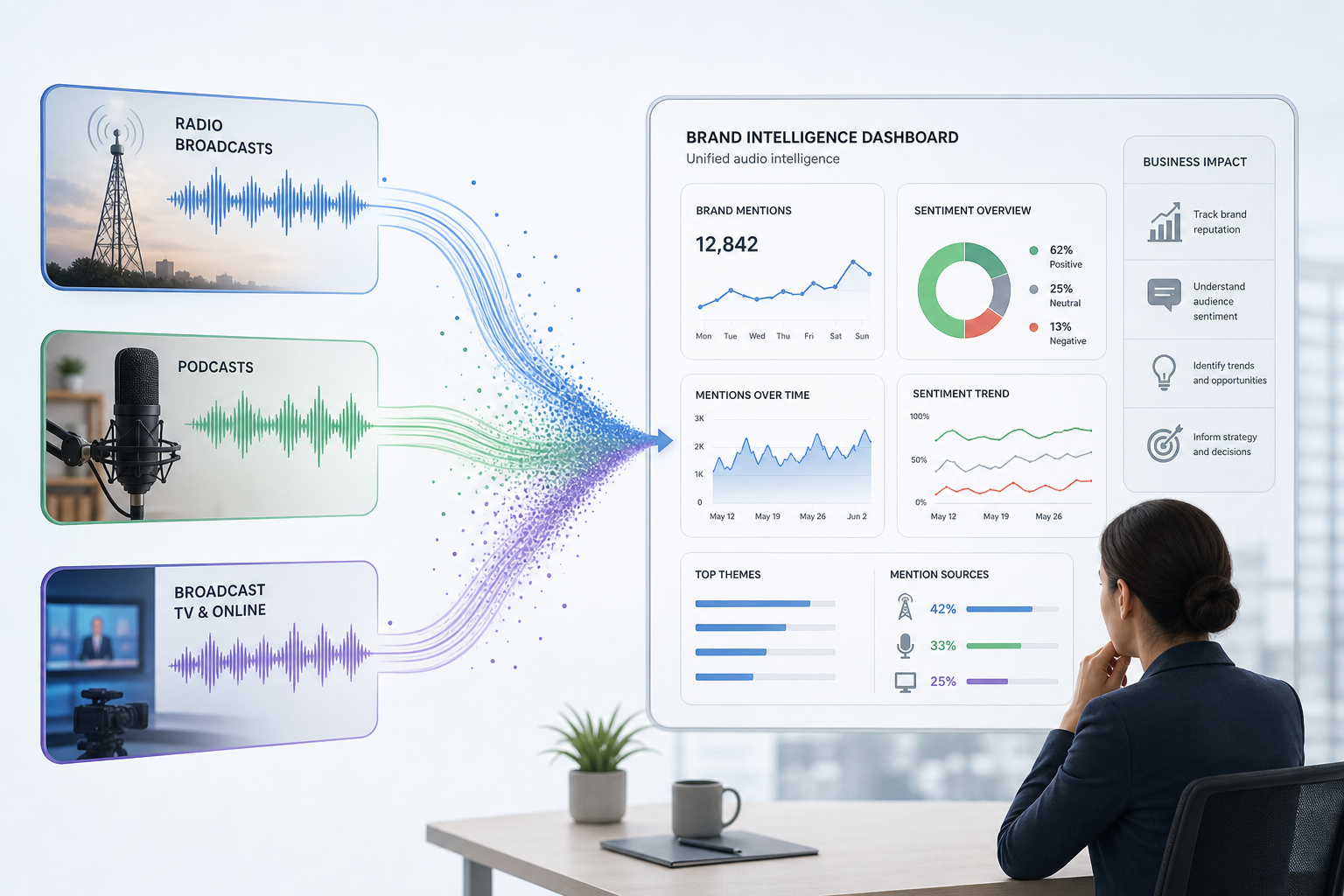
Once audio monitoring is in place, several concrete advantages follow. The most immediate is share of voice across audio channels: knowing what proportion of relevant conversations in your category feature your brand versus competitors. This is data that simply does not exist without systematic monitoring, and it changes how communications teams set targets and report results.
Sentiment tracking adds another layer. Understanding whether your brand is discussed positively, neutrally, or critically in audio content, and in what context, gives PR and marketing teams an early signal before sentiment shifts become visible in sales data or social media. Sentiment analysis at the entity level, rather than just flagging positive or negative words, is particularly valuable here because it correctly attributes tone to your brand rather than to the topic being discussed.
Competitor benchmarking rounds out the picture. Knowing how often a competitor is mentioned, in which programmes, and with what tone, is competitive intelligence that is difficult to gather any other way. For mid-sized brands without large research budgets, audio monitoring can substitute for expensive custom research on competitive positioning. Learn more about structuring that analysis in how to measure share of voice.
Cost considerations and the perception gap around audio ROI
The costs of audio monitoring vary depending on the scope of coverage, the languages and markets included, and the depth of analysis required. Entry-level tools focused on podcast verification start at modest monthly figures, while full-coverage platforms that include radio, broadcast, and streaming across multiple markets are priced at a different tier.
A critical context point for any budget conversation: research presented at the Tuning In 2025 conference found that a 2025 Nielsen CMO survey ranked AM/FM radio last in perceived ROI, despite actual performance data showing audio delivers strong returns. This perception gap matters for mid-sized brands. It means audio monitoring budgets are often under-justified internally, not because the value is not there, but because the measurement infrastructure to demonstrate it has historically been weak.
Building that infrastructure, whether through a dedicated platform or by integrating audio data into existing marketing mix models, is the core investment decision. The cost of monitoring is best evaluated against the cost of the blind spot it removes, including the risk of slow crisis response, missed competitive signals, and unattributed earned media value.
How to evaluate ROI before and after you invest
Evaluating ROI for audio monitoring requires a before-and-after framing. Before investing, the key question is: what decisions are currently being made without this data? If your brand runs PR campaigns that include radio or podcast outreach, and you cannot verify whether coverage happened or measure its tone, the monitoring cost is directly offset by the value of that verification.
After investing, ROI shows up in several ways. Faster crisis response reduces the window in which negative coverage can compound. Cleaner competitive data improves the quality of strategic decisions. And for brands running earned media campaigns, the ability to track mentions by programme, region, and sentiment makes post-campaign reporting far more precise.
For Nordic-market brands specifically, the language dimension matters. Generic monitoring tools often struggle with Swedish, Finnish, and Norwegian dialects, which means mentions get missed or misclassified. A platform with AI models trained specifically on Nordic languages and real-world broadcasts, achieving low word error rates, will produce more reliable data, and more reliable data produces more defensible ROI calculations. Reviewing how broadcast monitoring tools compare before selecting a platform can help you avoid paying for coverage gaps. Brand mention tracking is the foundation any ROI calculation ultimately rests on.
The brands that cannot measure their audio coverage are not just missing data; they are making strategic decisions based on an incomplete picture of how they are actually perceived.
Benefits
Faster crisis detection and response
Audio monitoring surfaces negative mentions in near real time, giving communications teams the chance to respond before a story escalates. The window between a critical radio segment airing and a brand's awareness of it can shrink from days to hours with automated monitoring in place.
Competitive benchmarking in audio
Tracking how often competitors are mentioned, in which programmes, and with what sentiment, gives mid-sized brands competitive intelligence that is otherwise unavailable without expensive custom research. This data directly informs positioning decisions and PR strategy.
Earned media attribution for campaigns
When a PR campaign targets radio or podcast coverage, monitoring provides the verification layer that proves coverage happened and characterises its tone. Without this, earned audio media is essentially unattributed, making it impossible to include in campaign ROI calculations.
Reduced manual listening hours
Communications teams that monitor audio manually, by listening to recordings or relying on tip-offs, spend significant time on a task that automated transcription and entity recognition can handle continuously. Redirecting that time to analysis rather than data collection is a direct efficiency gain.
Share of voice data across audio channels
Audio monitoring produces a consistent, comparable measure of how much of the relevant audio conversation your brand owns versus competitors. Share of voice in audio is a metric that simply does not exist without systematic monitoring, and it anchors communications reporting in objective data.
Audio monitoring ROI in practice
Consumer brand tracking podcast mentions post-launch
A consumer goods brand launches a new product line and runs a PR campaign targeting lifestyle and health podcasts. Without monitoring, the team relies on hosts to send confirmation emails, which rarely happens consistently. With audio monitoring in place, every mention across relevant podcasts is captured, transcribed, and tagged by sentiment. The brand discovers that three high-reach shows mentioned the product unprompted, in positive contexts, which had not been flagged by the PR agency. That data becomes part of the campaign ROI report and informs which podcast categories to prioritise in the next launch. Brand mention tracking is the capability that makes this kind of post-launch audit possible.
Regional company monitoring local radio for reputation
A regional energy company operating in northern Sweden wants to understand how it is being discussed on local radio stations during a period of public debate about energy infrastructure. Manual monitoring is impractical given the volume of regional programming. An audio monitoring platform with strong Nordic language capabilities captures mentions across local and national broadcasts, correctly identifying the company's name even when abbreviated or mispronounced by presenters. The communications team receives a weekly digest of mention volume, sentiment trend, and the specific programmes driving the most coverage, allowing them to prepare spokesperson briefings that directly address the narratives gaining traction. Sentiment analysis at the entity level is what makes the tone data actionable rather than generic.
Agency rolling up audio insights across multiple clients
A PR agency managing communications for several mid-sized brand clients needs to include audio media performance in its monthly reporting. Manually compiling radio and podcast mentions for each client is time-consuming and inconsistent. By using a monitoring platform with auto-label functionality, the agency sets up custom labelling rules for each brand so that mentions are automatically categorised by client, topic, and sentiment as they come in. Reporting that previously took a full day per client is consolidated into a structured dashboard view, and the agency can demonstrate earned audio coverage with the same rigour it applies to press and digital. Competitor benchmarking data is included in client reports to contextualise each brand's share of voice.
Audio media monitoring ROI: common questions answered
Start measuring what your brand earns in audio
If your brand invests in PR or communications that touch radio, podcasts, or broadcast, the case for audio monitoring is straightforward: you need to know whether coverage is happening, what tone it carries, and how it compares to competitors. Tonar covers audio and video across the Nordic market with AI trained specifically on Nordic languages, so the data you get is accurate enough to build a business case on.